From the edge of the circle
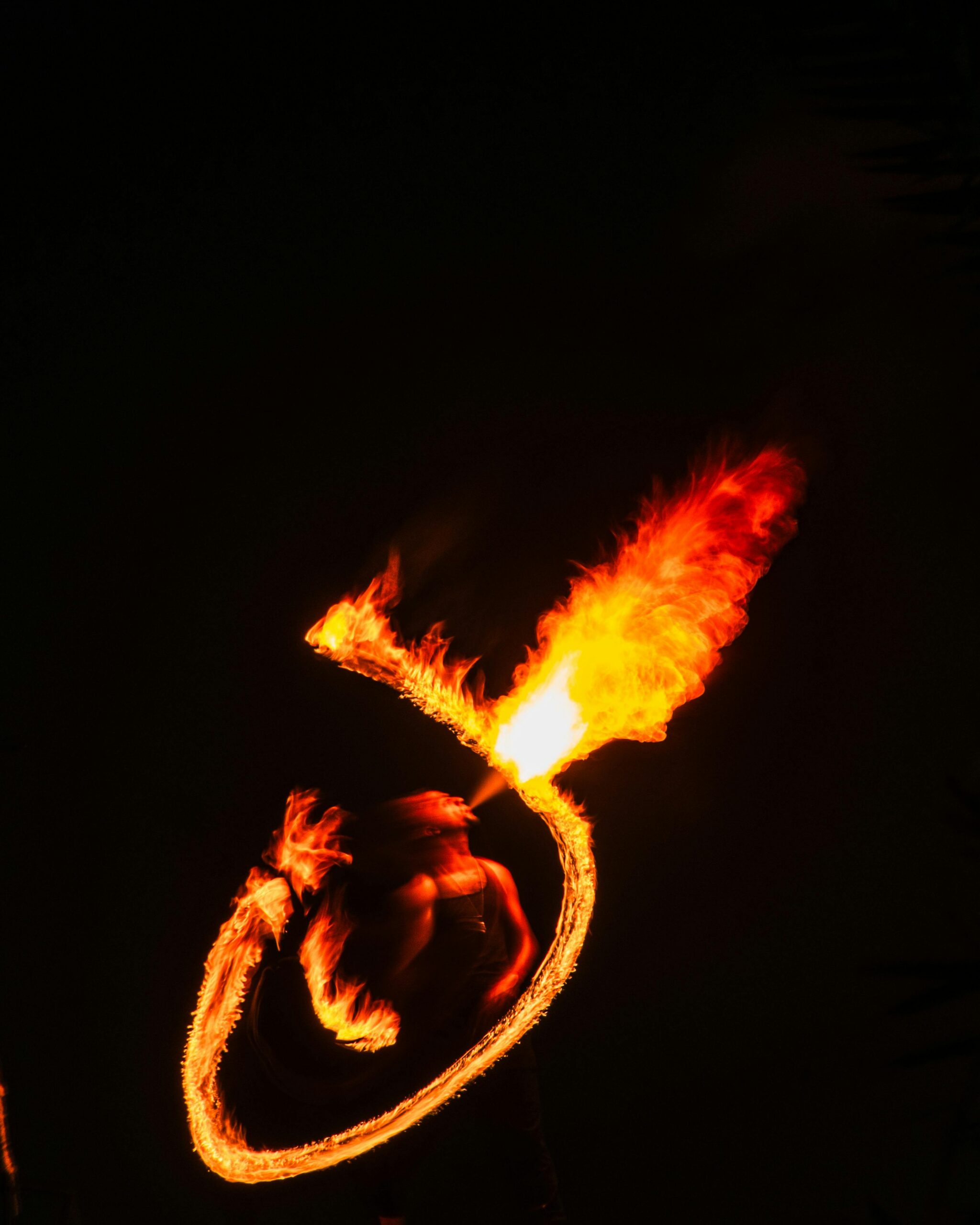
On the Paddock you first notice it just after dusk: a small circle of people moving in perfect rhythm, flames tracing arcs in the dark, sparks scattering like stars. You watch, mesmerised, from the edge of the circle. Every spin seems effortless, every movement precise…
…but there’s a quiet intensity there too.
And suddenly, almost without thinking, you want in.
You want to feel that rhythm, that focus, that pulse of energy moving through your hands and body.
You want to spin fire.
The illusion of effortlessness
From the outside, fire spinning looks like freedom.
Poi drawing perfect loops through darkness. A staff turning geometry into light. Hands that seem to know something the rest of the body has not yet learned.
But what you’re really seeing is control so practiced it has stopped announcing itself.
Every motion is held inside a frame of attention: distance, timing, wind, the weight of the object, the position of every other person in the circle.
At festivals like Kiwiburn, this is not incidental. The circle has structure. Space. Boundaries. Safety roles. People whose attention is not on performance but on conditions (wind, distance, fuel, timing, readiness).
Because what you are actually seeing is a community maintaining the conditions for risk to be shared safely.
And that’s the first truth of fire spinning:
It only looks like magic because someone has already done the work of making it safe enough to be seen.
The moment you cross the edge
The mistake is to imagine fire spinning begins with fire.
It doesn’t.
Well… sometimes people do start there, fast and a bit recklessly, but most don’t stay there long.
Mostly, it begins with being taught how not to break things.
And with fire safety. Always with fire safety.
Flow people are among some of the friendliest and loveliest people I’ve met. Some props are quite expensive or performance-only but I’ve found most people are happy to give you a go and teach you a trick if you ask.
At some point, maybe at Kiwiburn, maybe at a local jam, you move from watching to holding.
Not fire yet.
Something smaller.
Something you can whack yourself in the face with over and over and get away with just an ‘ow’ and a bruised ego.
The distance between watching and doing is not bravery. It is repetition. It is someone saying, gently, “not like that,” until your body understands what “like that” means.
The movement stops being something you remember and becomes something you feel in advance.
Only after that does fire enter the picture.
Trust as a skill
You don’t step into fire spinning alone.
Not really. Not ever.
Even when you are the one in the centre, there are others holding the edges of what you’re doing. Watching the wind, checking gear, keeping distance, noticing things you cannot see while you are inside the movement.
This is why fire circles feel different from most performance spaces.
There is no separation between audience and infrastructure. The safety is not invisible; it is shared.
People rotate through roles. People look up when you forget to. People intervene before anything that shouldn’t burn does.
What fire teaches you before it teaches you fire
Before fire spinning gives you skill, it changes your sense of attention.
You begin to understand space differently. Distance becomes felt. Other people stop being background and become part of your orientation.
And there is a particular kind of focus that emerges like something closer to listening than effort.
You cannot rush it.
You cannot fake it.
You can only practice until your body agrees with it.
Different props will teach you new skills, sometimes one will call to you. Like the dragon staff.
… the elusive, very pretty dragon staff.
I will learn it, I promise.
Get amongst it!
If you want to learn, you don’t need to wait for the right moment. You just need to find the right doorway.
You begin with people.
Flow arts communities in Aotearoa (poi, staff, hoop, juggling) are where most people start. Festivals like Kiwiburn can connect you with people who can show you what they’ve learned and help you find your starting point. Circus schools can provide more structured entry points.
But often the easiest way in is simply showing up to a jam or group and saying you’re curious.
For Wellington based Burners check out the Wellington Fire and Flow Club:
https://www.facebook.com/groups/fireandflowwgtn/
A Full Circle
You begin before you feel ready.
That is, almost always, how it works.
And eventually, you will find yourself at a circle at the Burn, sometime in the future, watching someone else for the first time.
They will be standing exactly where you once stood.
Thinking exactly what you once thought.
And the fire will still be doing what it has always done:
making attention visible.
Princess x
Photo Credit — Pexabay, Deepak Ramesha